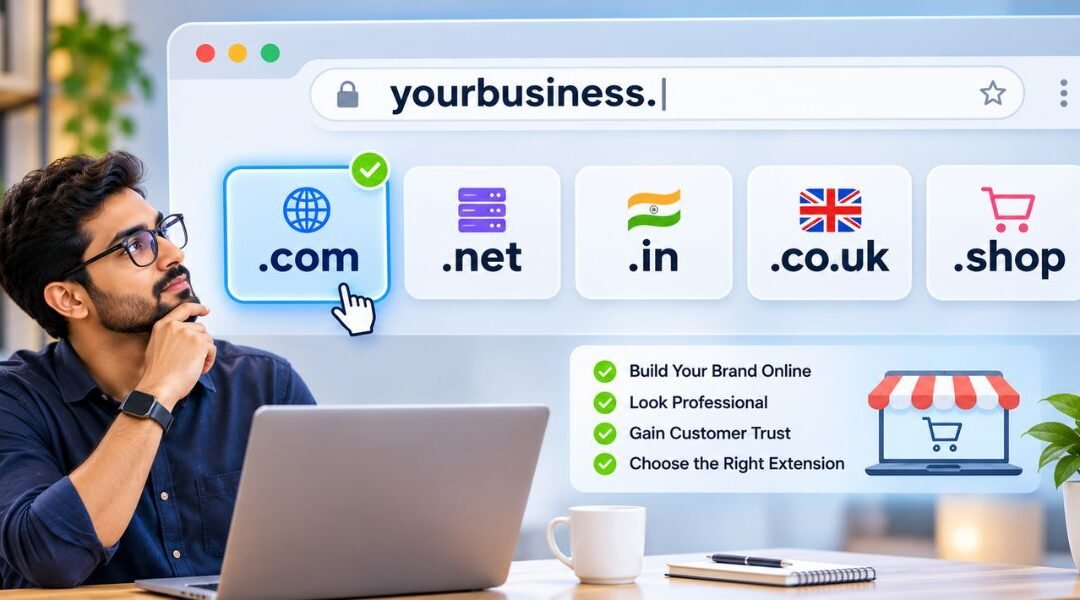
Types of Domain Names: Which Domain Should Your New Business Buy?
Types of Domain Names: Which Domain Should Your New Business Buy?
.com, .net, country or new extensions? Learn the types of domain names, how to choose one for your business, and where to buy it safely.

On this page
You've settled on a business name. You type it into a domain search box and the screen fills with options: .com, .net, .co, .shop, .online, your country's extension, each at a different price. Some are "premium". One is suspiciously cheap. Which one should you actually buy?
Your domain will sit on your website, your email, your business cards and every ad you run, so it's worth getting right the first time. This guide explains the different types of domain names in plain English, which one suits a new business, and how to buy it without falling into common traps.
Buy a short, easy-to-spell .com that matches your business name.
Your country domain (like .in, .co.uk or .com.au) is an equally strong choice.
Either way, register it in your own name, turn on auto-renew, and check the renewal price before you pay.
What Is a Domain Name? The Basics
The parts of a domain
A domain name is your website's address on the internet. Take shop.sweetcrumbs.com as an example:
- .com is the extension, also called the top-level domain (TLD).
- sweetcrumbs is the part you choose, usually your brand name.
- shop is an optional subdomain. You can create these for free once you own the domain, like blog.sweetcrumbs.com.
Domain vs hosting vs website
Think of it like a shop on a high street. The domain is your street address. Hosting is the building. Your website is everything inside it. You need all three, and you can buy them from different companies. Not sure which hosting to pick? Read our guide to the types of web hosting.
You rent a domain, you don't own it forever
Domains are registered for a set time, usually one to ten years, and then renewed. If you forget to renew, someone else can register your name. A bakery that loses its domain also loses its website and email overnight, which is why auto-renew is worth switching on.
Types of Domain Names Explained
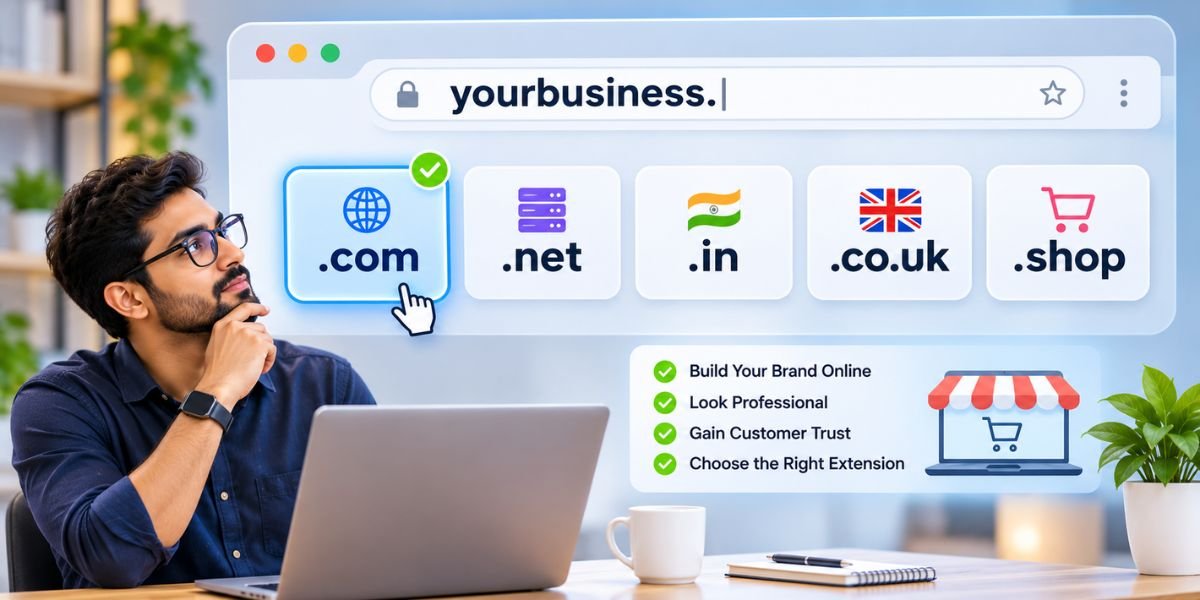
There are three main types of domain extension a business can choose from. Here's what each one means, with real-world examples.
Generic domains (.com, .net, .org)
These are the classics, open to anyone. .com is the most popular and trusted extension worldwide. It's what most people type without thinking, like amazon.com or yourbakery.com. .net was first meant for tech and network companies, and .org for non-profits like wikipedia.org, but today any business can use them.
Country code domains (.in, .co.uk, .com.au)
Every country has its own extension. A plumber in Sydney might use sydneyplumbing.com.au, and a boutique in London might use londonboutique.co.uk. These tell customers, and Google, that you serve that country. Some have rules: for example, a .com.au usually needs a registered Australian business.
New generic domains (.shop, .studio, .agency)
There are now hundreds of newer extensions that describe what you do, such as sweetcrumbs.shop or brightlens.studio. They're short, memorable and often available when the .com is taken. The downside is that some customers still type .com out of habit. Restricted extensions like .edu and .gov also exist, but they're only for approved universities and government bodies.
Domain types compared
| Type | Examples | Best for | Watch out for |
|---|---|---|---|
| Generic | .com, .net, .org | Almost any business | Short .com names are often taken |
| Country code | .in, .co.uk, .com.au | Businesses serving one country | Some have eligibility rules |
| New generic | .shop, .studio, .agency | Brand names when .com is taken | Customers typing .com by habit |
How to Choose a Domain Name for Your Business
Picking your extension
So what's the best domain extension for a business? If the .com version of your business name is available at a normal price, buy it. It's the safest choice whether you sell locally or worldwide.
If you only serve customers in one country, your country domain is just as good. A bakery in London does well with .co.uk, and a cleaner in Melbourne with .com.au. If you can, buy the .com too and point it to your main site.
If the .com is taken, don't settle for something clumsy like sweet-crumbs-bakery-online.com. Try your country domain, a relevant new extension like .shop, or a small tweak such as adding your city (sweetcrumbslondon.com).
| Your situation | Best choice |
|---|---|
| Selling online or to several countries | .com |
| Local business in one country | Your country domain, plus .com if available |
| .com taken, strong brand name | A relevant new extension like .shop or .studio |
| Non-profit or community group | .org |
Picking the name
A good domain name passes the "phone test": you can say it once and the other person types it correctly. Keep these rules in mind:
Five rules for a good domain name
- Short and simple: sweetcrumbs.com beats sweetcrumbshomemadecakesandcookies.com.
- No hyphens or numbers: people forget hyphens, and "4" vs "four" causes mistakes.
- Brandable, not keyword-stuffed: bestcheapplumbersydney.com looks spammy. A brand name builds trust and grows with you.
- Check trademarks and social handles: search your name on the WIPO Global Brand Database and on Instagram, Facebook and LinkedIn before buying, so you don't face a forced rebrand later.
- Protect variations: if budget allows, also buy a common misspelling and redirect it to your main site.
Does your domain affect SEO?
Not directly. Google has confirmed that new extensions like .shop or .guru are treated the same as .com and .org, and that keywords in the extension give no ranking boost. The one exception is country domains, which Google sees as a signal that your site targets that country. That helps local businesses, but can hold you back if you later sell abroad. Your rankings come from your content and reputation, not your domain, and that's where our SEO services focus.
Where to Buy Your Domain: Hostinger vs GoDaddy
Hostinger: best if you're buying hosting too
Hostinger keeps things simple and affordable, with a clean dashboard that beginners find easy. Its Premium and Business hosting plans include a free domain for the first year when you pay for 12 months or more, so it's a natural pick if you're setting up your website at the same time.
GoDaddy: best for range and phone support
GoDaddy is one of the largest domain registrars in the world, with a huge choice of extensions and support you can call. The catch: its checkout pushes a lot of add-ons, and renewal prices can be noticeably higher than the first-year offer. Untick what you don't need.
| Compared | Hostinger | GoDaddy |
|---|---|---|
| Best for | Beginners buying domain and hosting together | Wide choice of extensions, phone support |
| Ease of use | Very simple dashboard | Easy, but busy with upsells |
| Watch out for | Renewal price after the free or discounted first year | Add-ons at checkout and higher renewals |
What to check before you pay
Pre-checkout checklist
- Renewal price: the year-two price matters more than the first-year deal.
- Privacy protection: make sure your personal details are hidden from public domain records.
- Auto-renew: turn it on, and keep your payment card up to date.
- Ownership: the domain must be registered in your name or your business's name, never your developer's.
- Security: switch on two-factor authentication for your registrar account.
- Transfer lock: under current rules, a newly registered domain usually can't be moved to another registrar for 60 days.
Example: Choosing a Domain for a New Bakery
Priya is launching Sweet Crumbs, a home bakery that delivers cakes across her city. She wants a website and a professional email address.
sweetcrumbs.com is taken by an inactive site, and the owner wants a premium price for it. Her first idea is sweet-crumbs-bakery-online.com, which is long, hyphenated and hard to say out loud.
- sweet-crumbs-bakery-online.com: too long, hyphens, easy to mistype
- sweetcrumbs.shop: short and brandable, but customers may type .com
- Her country domain: short, local, available, and trusted by local customers
- sweetcrumbscakes.com: clear and available, a good backup
She registers her country domain as the main site, buys sweetcrumbscakes.com as a backup that redirects to it, and grabs matching Instagram and Facebook handles. She registers both through her hosting provider in her own name, with auto-renew and privacy protection switched on.
You don't need the perfect .com. A short, local, easy-to-spell domain that you own and protect is worth far more than a clumsy name with the "right" extension.
Need Help Picking the Right Domain?
A domain is a small purchase with long-term consequences. Book a free consultation with Digital Roof. We'll help you shortlist names, check what's available, and set up your domain, hosting and business email properly, in your name, from day one. It's part of our website development services.
Book My Free Domain ConsultationBased in Australia? See our web design services in Sydney, Melbourne, Brisbane, Perth, Adelaide and the Gold Coast.
Frequently Asked Questions
Is .com still the best domain for a business?
For most businesses, yes. It's the most trusted and most remembered extension. A country domain is just as good if you only serve one country.
Does my domain extension affect SEO?
Not directly. Google treats new extensions like .shop the same as .com. Country domains signal your target country, which helps local visibility.
Can I change my domain name later?
Yes, but it takes work. You'll need redirects from the old domain, updated links and new business materials, and rankings can dip for a while. It's far easier to choose well at the start.
Should I buy more than one domain?
If budget allows, buy your main domain plus your country domain or a common misspelling, and redirect them to your main site.
Who should own my domain if a developer sets it up?
You. Always register the domain in your own or your business's name, with login details you control. Your developer can be added as a user.
How much does a domain cost?
A standard .com typically costs around $10–20 a year, though first-year deals are often cheaper. Premium and some new extensions cost more, so always check the renewal price.
Keep Reading
Ajay Hooda is the co-founder of Digital Roof, a founder-led digital marketing studio specializing in SEO, website development and content. He holds a PG Diploma in Digital Marketing and Communication from MICA, is Google-certified, and has worked with small businesses and international clients since 2019.