Over the past year, a new category of software showed up in every marketing tool roundup: the "AI visibility tracker." It promises to tell you whether ChatGPT, Perplexity, or Google's AI Overviews mention your business when someone asks a relevant question. Prices for these tools typically run $200 to $500 a month, and vendors are moving fast — Semrush, Ahrefs, HubSpot, and a wave of newer startups like Profound and Scrunch have all launched competing products in the last twelve months.
If you own a business and someone — an agency, a consultant, a tool's own marketing page — has told you that you need to start tracking your "AI visibility" right now, it's worth pausing before you buy anything. The data on how AI search actually works, published by the same companies selling these tools, tells a more complicated story than the sales pitch does.
What "AI visibility" actually means
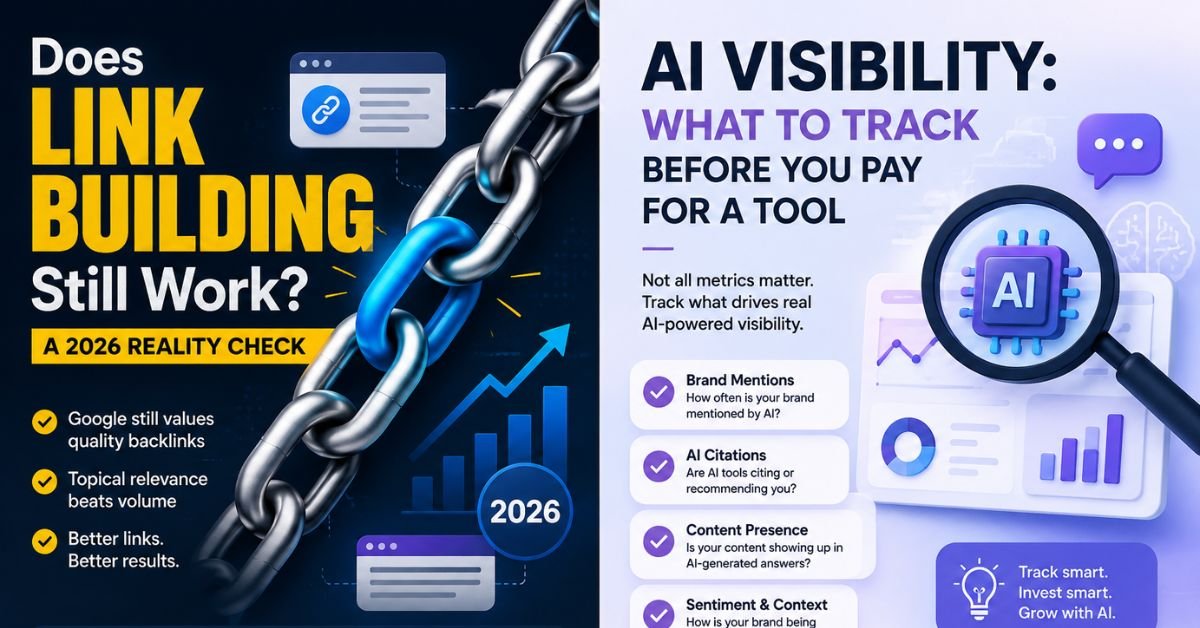
"AI visibility" is shorthand for how often, and how accurately, your business shows up when someone asks an AI assistant a question related to what you do. That could mean ChatGPT recommending you by name, Perplexity citing your website as a source, or Google's AI Overviews summarizing your services alongside competitors.
It's tempting to treat this like a new version of search rankings — track your "position," report on it monthly, optimize toward a number. That comparison breaks down quickly. There's no fixed results page. The same question can get a different answer twice in a row. And a business can be recommended by an AI system without its website ever being cited or clicked.
Tom Capper, a search consultant who does regular AMAs on Moz's blog, put it this way in a recent one: “AI search doesn't send traffic the same way traditional search did… A recommendation can still be a win even when your site isn't the one cited.” If someone asks an AI assistant for a plumber recommendation and it names your business while citing a local directory instead of your homepage, that's still visibility — even though nothing in your analytics will show it.
The data behind the sales pitch
Before spending money on a tracking tool, it's worth understanding what the industry's own research says about how AI mentions actually get distributed. Two recent studies are useful here, and both come from companies that sell AI visibility tools — which makes the caution in their own findings notable.
Semrush, working with SEO analyst Kevin Indig, tracked 1,094 US product and service categories in ChatGPT from January through June 2026. The finding: only 15.2% of categories had a clear brand "owner" — meaning one company that reliably appeared across the majority of related questions. For a business to count as a category owner, it had to appear in at least four of five related prompts with a real lead over whoever came second. The other 85% of categories showed no consistent winner. The study also found that only 21% of the most-cited websites in a category belonged to the most-mentioned brand — being mentioned by name and being the source an AI cites are frequently two different companies entirely.
Moz ran a separate experiment, generating 50,000 AI "fan-out" prompts (the follow-up questions an AI system generates behind the scenes to answer a broader query) across 1,000 subtopics. Researcher Dr. Pete Meyers found that even when a brand and its competitors were deliberately fed into the prompt-generation process as hints, only 12.8% of the resulting prompts ended up mentioning any brand at all. Most of the "conversation" an AI system has with itself while researching an answer never touches brand names — it's about the topic, not the company.
Put together, these numbers suggest that for the large majority of categories and queries, there's no stable "ranking" to track yet, and a fair amount of what a $300/month tool would report back to you is noise from month to month rather than a signal you can act on.
What Google Search Console will (and won't) tell you for free
You don't need a third-party subscription to see some of this. In June 2026, Google added generative AI performance reporting directly to Search Console, at no cost, for sites in the rollout. It's worth knowing exactly what it does and doesn't cover before you assume it replaces a paid tool — or before you assume you need a paid tool to get this data at all.
| What Google's report shows | What it doesn't show |
|---|---|
| Impressions in AI Overviews, AI Mode, and AI-powered Discover | Click-through rate |
| Which pages appeared | Individual queries or prompts |
| Country-level breakdown | Which AI-generated answer your page appeared in |
| Device breakdown | Competitor comparisons |
That's a real limitation. You'll know your pages showed up somewhere in Google's AI features, but not what was asked, what was said about you, or whether a competitor was mentioned instead. Google has also confirmed the rollout is still limited to a subset of sites, starting in the UK, so not every Search Console account has access yet.
A DIY check you can run this week
Before paying for a dedicated platform, there's a manual version of the same exercise that costs nothing but half an hour:
- Write down the 5–10 questions a real customer would type into ChatGPT or Google's AI Mode when they're close to hiring someone in your category — not generic industry questions, but the actual buying-decision ones ("best [service] in [your industry] for [specific need]").
- Ask each one in ChatGPT, Perplexity, and Google AI Mode, in a fresh/incognito session so past history doesn't skew the answer.
- Record three things for each answer: were you mentioned, were you cited as a source, and was the description of your business accurate.
- Repeat monthly. Consistency matters more than volume — the Semrush data above shows that a single appearance means very little; a business only "owns" a topic once it shows up reliably across related questions.
This won't give you impression counts or trend charts, but it answers the question that actually matters for a small or mid-sized business: not "what's my score," but "if a customer asked, would I show up, and would the answer be right."
When a paid tool is actually worth it
None of this means AI visibility tools are a bad purchase for everyone. They start to earn their cost once a few things are true for your business:
- You compete in a category with real commercial stakes per lead (legal, healthcare, financial services, high-ticket home services) where losing a recommendation to a competitor is expensive.
- You operate across enough locations, product lines, or service categories that manually checking prompts monthly isn't realistic.
- You already have a working SEO and content program in place, and AI visibility tracking would be additive intelligence — not a replacement for the fundamentals.
If none of those apply yet, the DIY check above, combined with Search Console's free reporting, covers most of what a small business actually needs to know for now.
What actually moves the needle
Both studies point to the same underlying lever: AI systems build their answers from sources they consider trustworthy on a given topic, and a citation on a well-regarded third-party site does more for visibility than anything you can change on your own homepage alone. That's a case for two things that predate the "AI visibility" trend by years: getting accurate, consistent coverage from other reputable sites in your industry (what's traditionally called digital PR or earned media), and making sure your own site's content clearly and accurately describes what you do, so that when an AI system — or a person — does land on it, the description holds up.
Our SEO services work is built around exactly this: earning the kind of third-party visibility that both AI systems and traditional search reward, rather than chasing a vanity metric that resets every month. If your own site's content is thin or outdated, that's also worth fixing first — our content creation work focuses on making sure what's on your pages actually describes your business accurately, which matters whether the reader is a person or a language model. None of that helps if AI crawlers can't reach or parse your site in the first place, so it's also worth confirming the technical basics are solid — our website development work covers exactly that groundwork.
Takeaway
The AI visibility tool market grew fast, but the research these same companies have published shows the underlying signal is still noisy: most categories don't have a stable "winner," most AI-generated questions never mention a brand, and even Google's own free reporting only shows impressions, not the full picture. For most small and mid-sized businesses, a monthly manual check plus free Search Console data will tell you what you need to know for now. If you want help figuring out whether your business is showing up accurately — in AI answers or regular search — get in touch and we'll walk through it with you.
FAQ
Do I need to buy an AI visibility tool right now?
Not necessarily. Unless you're in a high-stakes category with real per-lead value, or managing visibility across many locations or product lines, a monthly manual check across ChatGPT, Perplexity, and Google AI Mode plus free Search Console data covers most of what a small business needs.
What does Google Search Console's new AI report actually show?
Impressions, which pages appeared, country, and device — for sites in Google's limited June 2026 rollout. It does not show click-through rate, the specific questions asked, or which AI-generated answer your page appeared in.
Can my business be recommended by AI without my website being cited?
Yes. AI systems can name your business while citing a different source, like a directory or review site, for the underlying information. That's still a form of visibility, even though it won't show up in your website analytics.
How often should I check my AI visibility manually?
Monthly, using the same set of buying-decision questions each time. A single appearance in an AI answer means very little on its own — research from Semrush found that reliable, repeated appearance across related questions is what separates a real "topic owner" from a one-off mention.
Does having good SEO automatically improve AI visibility?
It helps, but it's not the same thing. AI systems weigh third-party coverage and how consistently other trusted sites describe your business, alongside your own site's content. A strong SEO and digital PR foundation supports AI visibility, but ranking well in traditional search doesn't guarantee an AI system will recommend you by name.