Two things happened in the SEO industry this week that, on their own, look like inside-baseball tool updates. Put together, they explain something a lot of business owners are seeing on their own analytics dashboard right now: "Direct" traffic climbing while "Organic Search" looks flat or shrinking.
If that's your dashboard, the instinct is to assume your SEO has stopped working. Before you act on that, it's worth five minutes to check whether it's actually working better than your reports show.
What "Direct" Traffic Actually Means
Google's own documentation is blunt about this: the Direct channel is what a visit gets labelled when Google Analytics can't identify where it came from. No referrer, no campaign tag, no recognisable source. It's less "this person typed your URL from memory" and more "we genuinely don't know."
That catch-all bucket has always absorbed some noise: bookmarks, links in PDFs, links from apps that strip tracking data. But a new source of noise has become large enough to actually move the number, and it's tied directly to how people are now finding businesses.
For most small and mid-size businesses, nobody is actively watching for this. A monthly report lands, Organic Search is flat or slightly down, Direct is up, and the natural conclusion is that whatever's driving Direct, brand recognition, word of mouth, repeat customers, is doing the heavy lifting instead of search. That conclusion might be right. Increasingly, though, it's wrong in a specific and checkable way.
The New Reason: AI Citation Clicks Are Landing as "Direct"
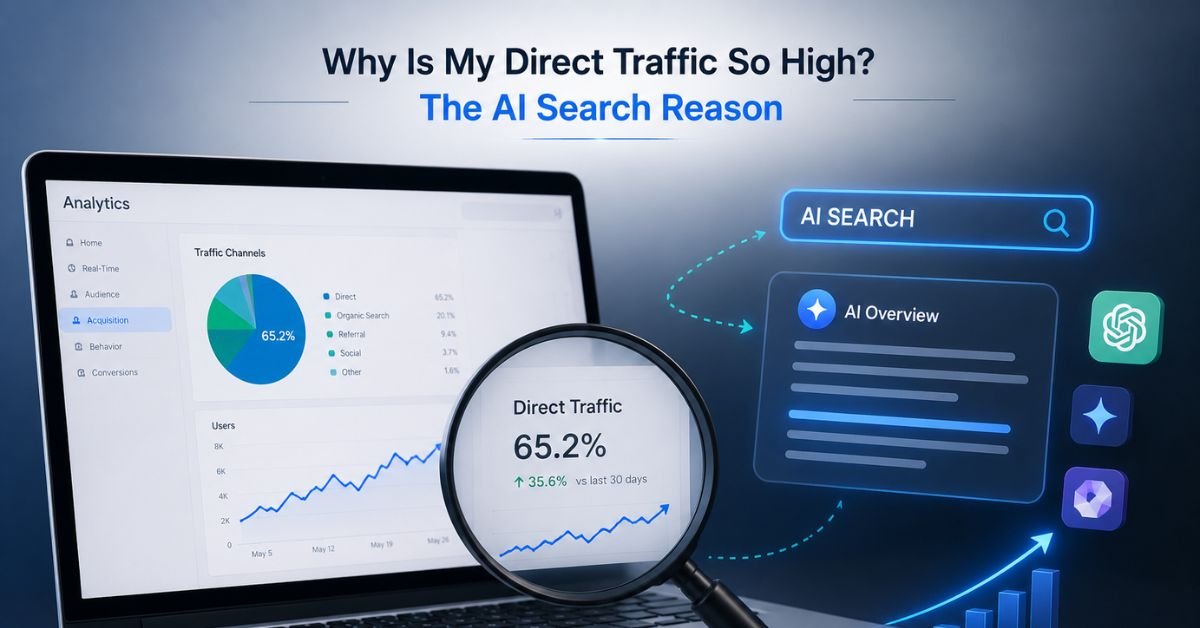
A nine-month study tracking over 51,000 AI Overview citation events, published this week, found that on average 22.4% of clicks from Google's AI Overviews were misattributed to the Direct channel instead of Organic Search. In the worst month tracked, that figure hit 29.3%.
| Metric | Finding |
|---|---|
| AI Overview citation events tracked | 51,200+ over 9 months |
| Average share misattributed to Direct | 22.4% |
| Worst month (May 2026) | 29.3% misattributed |
The mechanism is simple once you see it. When someone clicks a link inside an AI Overview, ChatGPT, or Perplexity answer, the click often arrives at your site without a referrer header, the piece of information a browser normally sends that says "this visitor came from Google" or "this visitor came from Bing." AI interfaces don't consistently pass that along. Google Analytics can't label a visit "AI search" if it has no way of knowing that's what happened, so it defaults to Direct.
This isn't a fringe issue limited to one study. Independent analysis of AI referral traffic more broadly has found a similar pattern: a majority of clicks from AI chat tools arrive with no referrer at all and land in Direct by default, not just occasionally, but as the normal behaviour of how these platforms currently work.
It's Not Just Analytics — "Search Volume" Is Shifting Too
The second development is on the input side, not the output side. Ahrefs is rolling out what it calls "AI-adjusted Volume", a blended estimate that combines traditional Google search volume with modelled demand from ChatGPT, Perplexity, and other AI platforms. No AI provider publishes real prompt data publicly, so this is Ahrefs' best estimate, not a direct measurement, but it's about to become the default. The toggle to see plain, old-fashioned Google search volume disappears from Ahrefs' Brand Radar reports on August 31, 2026.
If your SEO reporting includes keyword volume or demand figures from a tool like this, some of what you're being shown may already be a blended AI estimate rather than a pure Google number, whether or not anyone has mentioned the change.
Ahrefs' own reasoning for the change is worth understanding, not just the deadline. No AI platform, not ChatGPT, not Perplexity, not Gemini, publishes real prompt data the way search engines have historically shared search volume data with tool vendors. So the new figure is modelled: it takes a prompt's closest matching Google keyword, looks up that keyword's known search volume, then applies a platform-specific ratio built from Ahrefs' own traffic data to estimate how often something similar gets asked inside AI tools. It's a reasonable estimate, but it is an estimate, built on a proxy, not a direct count. Worth knowing which one you're looking at before you make a decision based on it.
Why This Actually Matters for Your Business
There are two ways to get this wrong, in opposite directions.
The first is concluding your SEO has stopped working because "Organic Search" looks flat while "Direct" climbs, and cutting the budget for a channel that's actually performing, just being counted in the wrong column. If a chunk of your real organic and AI-search performance is quietly landing in Direct, your reports are underselling what's working.
The second is the opposite mistake: treating a rising Direct number as proof of growing brand strength, "people know us well enough to type our name straight into the address bar", when a meaningful share of it is just AI referral leakage. Neither read is safe without actually checking.
This is also a budget conversation, not just a curiosity. Marketing spend gets allocated based on which channels appear to perform. If a content or SEO investment is quietly earning AI citations that show up as Direct instead of Organic, the reporting can make that spend look weaker than it is, right at the point someone is deciding whether to renew it.
A Check You Can Run Yourself
This takes about five minutes in Google Analytics 4 and needs no extra tools. Go to Reports, then Acquisition, then Traffic acquisition, and filter the table down to the Direct channel. Then add or switch to the Landing page dimension.
Look at what's actually showing up. A homepage getting Direct traffic is normal, people do type in short, memorable URLs. A deep blog post, a comparison page, or an FAQ page with a long, specific URL getting a steady stream of "Direct" visits is a different story. Almost nobody memorises or types a URL like that from scratch. That pattern is a strong sign you're looking at AI-citation clicks landing in the wrong bucket, not genuine direct visits.
Cross-check those same pages against Search Console, if they're also picking up impressions for informational, question-style queries, that reinforces the read: people are finding this content through search and AI answers, then arriving with the trail erased.
What to Ask Your SEO or Agency
- Ask whether your reporting separates likely AI-citation traffic from genuine direct visits, at the landing-page level, not just the channel total.
- Ask whether the keyword or demand figures in your reports are classic Google search volume, an AI-adjusted blend, or unlabelled either way.
- Ask for a technically clean website and analytics setup as a baseline. Custom channel groupings and landing-page pattern checks only work if the tracking underneath them is sound.
- If your SEO reporting still only shows channel-level totals with no landing-page detail, that's worth raising, not because the agency is doing something wrong, but because the standard GA4 setup genuinely can't tell this story on its own.
None of this changes what actually earns the click in the first place: content clear and specific enough that an AI system chooses to cite it, and a search engine chooses to rank it. That's still the same job as before, it's the measurement of the result that's gotten harder. If your content is thin or vague, no amount of attribution cleanup will fix the underlying problem.
FAQ
Why is my Direct traffic suddenly so high?
It could be genuine, but a documented and growing cause is AI search. When someone clicks a link from an AI Overview, ChatGPT, or Perplexity answer, the click often arrives without a referrer header, so Google Analytics can't identify the true source and defaults to Direct.
How much AI traffic actually gets miscounted as Direct?
A nine-month study tracking over 51,000 AI Overview citation events found an average misattribution rate of 22.4%, peaking at 29.3% in one month. Broader analysis of AI chat referral traffic beyond just AI Overviews has found even higher shares landing in Direct.
How do I check if my Direct traffic is really AI search?
In GA4, filter Traffic acquisition to the Direct channel and switch to the Landing page dimension. Deep, specific pages, blog posts, comparisons, FAQs, getting steady Direct visits is a strong sign of AI-citation leakage rather than genuine typed-URL traffic.
What is "AI-adjusted Volume" and why does it matter?
It's a new metric from Ahrefs that blends traditional Google search volume with modelled AI-platform demand, since no AI provider shares real prompt data publicly. It's becoming the default in Ahrefs' reporting from August 31, 2026, so keyword and demand figures you're shown may already include this blend.
Should I stop trusting my Organic Search numbers?
No, but treat them as a floor, not the full picture. Your real organic and AI-search performance is likely at least as good as your reports show, and possibly better, since some of it is currently being counted as Direct instead.
The Takeaway
If your Direct traffic has been creeping up while Organic Search looks stagnant, that's not automatically a verdict on your SEO. It might be AI search working exactly as intended, just landing in the wrong column of your report. A five-minute landing-page check in GA4 will tell you which story is true for your business. If you'd rather have someone else run that check and explain what it means for your numbers, get in touch and we'll walk through it with you.