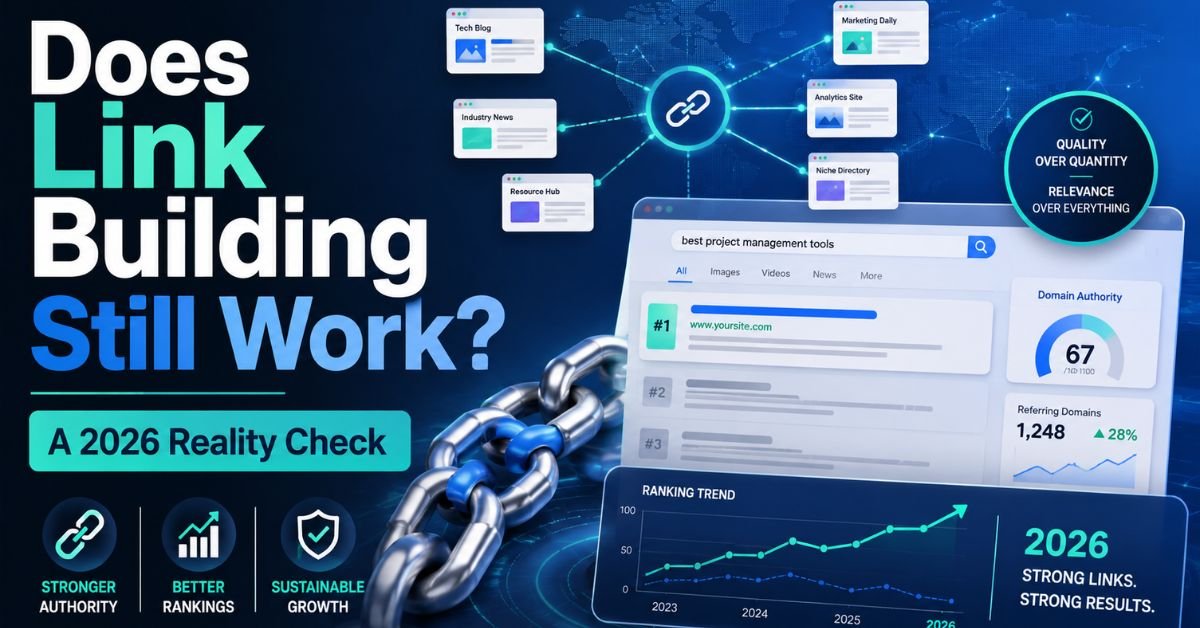
Google's own search advocate has said the company needs "very few links" to rank a page. This week, a fresh study of 35,000 real ChatGPT citations found that Reddit and Wikipedia together outrank every news publisher on earth as a source AI search trusts. So why are small businesses still being sold "50 backlinks a month" packages like it's 2015?
If you're a business owner paying for SEO, or being pitched on it, this is worth five minutes of your time. It's not a technical question. It's a budget question: where should your money actually go in 2026?
What Google Actually Said About Links
Backlinks have been central to SEO since Google's founding. PageRank, the original algorithm, was built almost entirely on the idea that a link from one page to another was a vote of trust. For two decades, "get more links" was close to the entire industry's advice.
That's been changing for longer than most business owners realise. In April 2024, Google's Gary Illyes, a longtime member of Google's Search Relations team, told a room of SEOs at SERP Conf in Bulgaria: "We need very few links to rank pages… Over the years, we've made links less important." The remark travelled fast enough through the industry that Illyes later half-joked on X that he "shouldn't have said that."
Read that carefully, because the nuance matters. Illyes didn't say Google ignores links. He said Google needs fewer of them, and weighs each one less than it used to. For a business owner, the practical translation is this: quantity-based link building, the kind sold in bulk monthly packages, has been losing value since at least 2024. That's a Google story, not an AI story. AI search has simply made the gap impossible to keep ignoring.
What's Actually Earning Visibility Now
Search Engine Land published an analysis on August 13, 2026 of 35,000 real ChatGPT citations across industries. The finding: user-generated content platforms, mainly Reddit, Wikipedia, and LinkedIn, account for 17.1% of all cited domains. That's more than four times the share held by news publishers, which came in at 4.0%. Wikipedia, Reddit, and LinkedIn alone make up 99% of those UGC citations.
| Citation source type | Share of AI citations |
|---|---|
| User-generated content (Reddit, Wikipedia, LinkedIn) | 17.1% |
| News publishers | 4.0% |
Why does a Reddit thread outweigh a press mention in an AI model's eyes? Large language models are trained heavily on forum and community text, and they tend to treat it as a proxy for authentic, unpaid opinion, the opposite of a press release or a sponsored post. A mention of your business in a niche forum or an industry community can carry real weight with an AI answer engine, even with no link attached at all.
That's not a reason to abandon publisher coverage or PR entirely. It's a reason to stop assuming publisher backlinks are the only thing that counts, when the data says they're currently the smaller share of what AI models actually cite.
This matters more for small and mid-size businesses than it does for national brands. A large brand already has a press archive and a Wikipedia page working in its favour. A local plumber, a regional accounting firm, or a niche ecommerce store rarely does, but that same business often already has something more valuable sitting unused: real customers talking about it in Facebook groups, local subreddits, and review threads. That's the raw material AI models are reading. Most businesses just haven't thought to treat it as an SEO asset.
The "Ghost Citation" Problem
Before you redirect your entire budget toward Reddit threads, one more data point matters. Semrush's research on what it calls "ghost citations" found that 62% of AI citations don't actually produce a visible brand mention in the answer a user reads. In other words: an AI tool can pull facts from your website or a page describing your business, and never once say your business's name to the person asking the question.
This cuts both ways for a business owner. It means citations alone aren't the finish line, being named matters as much as being sourced. And it means any "AI visibility" report that counts citations without checking whether your brand name actually appears in the answer is overstating how visible you really are. If a tool or an agency shows you a citation count and nothing else, ask to see the actual answers.
So Should You Stop Paying for Backlinks?
No, but you should stop paying for the wrong kind, and this is the part most agencies won't tell you, because it's their product.
If your current spend is a fixed number of links per month from anonymous "guest post" networks, private blog networks, or link farms, that's exactly the product Google has been devaluing since 2024. It's also not the kind of mention that shows up in the AI citation studies above. You're paying twice for something that's worth less than it used to be in either system.
What still earns its budget is narrower: a handful of genuinely relevant links from real publications, earned through digital PR or expert commentary rather than bought in bulk, sitting on top of a technically solid website that's actually worth linking to in the first place. If your site itself is the weak link, that's a website development problem before it's a link-building one.
There's also a trust cost to the old playbook that rarely makes it into the sales pitch. Google has spent years penalising sites caught in obvious link schemes, and the same low-quality networks that no longer move rankings much can still trigger a manual action if Google decides they cross the line. That's a real, if less common, downside risk attached to a tactic that's already delivering less upside than it used to. Weigh that against the near-zero downside of building a genuine review and community presence, and the budget decision gets easier.
| Old playbook | Better use of the same budget in 2026 |
|---|---|
| Fixed monthly quota of links from anonymous or low-quality sites | A small number of earned links from relevant, real publications |
| No presence outside your own website | Active, accurate presence on the review sites and forums your customers actually use |
| Reporting that only counts link volume | Checking whether your brand is actually named in AI answers, not just cited |
A Check You Can Run Yourself
This takes five minutes and costs nothing. Open ChatGPT, Gemini, or Google's AI mode and ask the question your customers would actually ask, something like "best [your service] in [your city]" or "who does [what you do] well." See if your business is named. Then, separately, search "[your business name] reddit" and "[your business name] reviews" in a normal search engine. If neither returns anything meaningful, no amount of paid backlinks is going to fix what's actually missing: a genuine footprint in the places AI models are reading from.
The pattern holds up across the client sites we work on: businesses with an active review profile and some real community presence tend to get named in AI answers even when their backlink count is modest. Businesses with a large but generic link profile and no community footprint often don't, however many links point at their homepage.
What to Do With Your SEO Budget Instead
- Keep a small, high-relevance link-building effort aimed at real publications and partners, not volume vendors selling links by the dozen.
- Put real budget into content worth citing on its own merits: original data, direct answers to the questions your customers actually ask, pages that don't need a backlink to be useful.
- Claim and actively manage your presence on the review sites and forums relevant to your industry. This is where AI models are increasingly pulling from, with or without your permission.
- Get a specialist's read on your current link spend rather than guessing. A proper SEO review will show whether your current spend matches what's actually moving the needle for your business today.
FAQ
Is link building dead in 2026?
No. Google's own team has said links matter less than they used to, not that they don't matter at all. What's changed is that link volume from low-quality sources carries little to no benefit, while a smaller number of relevant, earned links still helps.
Do unlinked brand mentions help SEO?
They help AI visibility more directly than they help traditional SEO. Large language models are trained on raw text, not just hyperlinks, so a mention of your brand in a forum thread or review, even without a link, can influence whether an AI tool names or cites you.
How many backlinks does a small business actually need?
There's no fixed number to chase. Google's Gary Illyes has said the company needs "very few links" to rank a page well, so the goal should be relevance and quality over raw quantity.
What is a "ghost citation" in AI search?
It's when an AI tool pulls information from your site as a source but never actually names your brand in the answer the user sees. Semrush's research found this happens in 62% of AI citations, meaning being a source and being visible to the customer are two different things.
Should I fire my link-building agency?
Only if they can't tell you where your links are actually coming from. If the answer is a fixed monthly quota from unnamed sites, that spend is better redirected toward digital PR, reviews, and genuine community presence.
The Takeaway
Links aren't dead. The link-building industry's old pitch, more links, delivered monthly, from wherever, is. Google has been saying so since 2024, and AI search has just made the gap impossible to ignore. If you're not sure whether your current SEO spend matches where visibility is actually coming from now, get in touch and we'll show you exactly what's working and what isn't.